Current issue
Online first
Archive
About the Journal
Editorial Office
Editorial Board
Publisher
Reviewers
Editorial policies
Ethical standards and procedures
Abstracting and indexing
Contact
Subscriptions & Orders
Instructions for authors
Article processing charge (APC)
English language editing services
Books and Events
Books
Events


SHORT COMMUNICATION
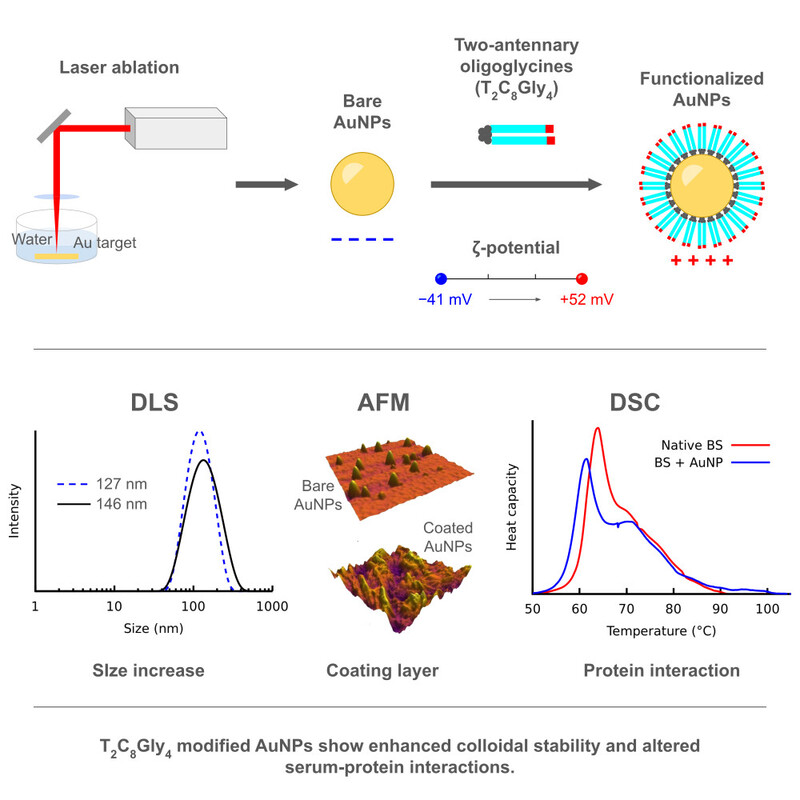
Oligoglycine-functionalized gold nanoparticles: physicochemical characterisation and serum protein interactions

1
Medical Faculty, Medical University, Sofia, Bulgaria
2
Institute of Biophysics and Biomedical Engineering, Bulgarian Academy of Sciences, Bulgaria
3
Institute of Physical Chemistry, Bulgarian Academy of Sciences, Bulgaria
4
National Centre of Excellence Mechatronics and Clean Technologies, Sofia, Bulgaria
5
Institute of Optical Materials and Technologies, Bulgarian Academy of Sciences, Bulgaria
6
Institute of Electronics, Bulgarian Academy of Sciences, Bulgaria
7
National Specialized Hospital for Active Treatment of Hematological Diseases, Sofia, Bulgaria
Submission date: 2025-12-26
Final revision date: 2026-06-29
Acceptance date: 2026-07-15
Publication date: 2026-09-21
BioTechnologia 2026;107(3):221-228
KEYWORDS
TOPICS
ABSTRACT
The physicochemical behavior of gold nanoparticles (AuNPs) functionalized with two-antennary oligoglycines is studied by analyzing the colloidal stability and size distribution via dynamic light scattering, the surface-charge reconfiguration through zeta-potential, the nanoscale structure using atomic force microscopy, and the thermodynamic interactions with blood serum using differential scanning calorimetry. These analyses provide an initial assessment of the suitability of the two-antennary oligoglycines as a supramolecular surface-engineering ligand for AuNP-based biomedical applications. The two-antennary oligoglycines form stable complexes with AuNPs, creating a coating layer and reversing surface charge. The interaction between bare nanoparticles and blood serum is weak, primarily affecting albumin. On the other hand, the oligoglycines interact strongly with the blood serum proteins altering their stability. Together, these results demonstrate that two-antennary oligoglycines serve as both a stabilizing and functionalizing layer, thereby enhancing nanoparticle stability and modulating biological interactions. This highlights their potential for the design of well-defined nanomaterials and for applications in drug delivery and other biomedical fields.
REFERENCES (16)
1.
Arabadzhieva D, Gyurova A, Alexandrova L, Chinarev A, Tsygankova S, Tuzikov A, Khristov K, Ranguelov B, Mileva E. 2019. Smart complex fluids based on two-antennary oligoglycines. ChemSusChem. 12: 672–683. https://doi.org/10.1002/cssc.2....
2.
Boisselier E, Astruc D. 2009. Gold nanoparticles in nanomedicine: preparations, imaging, diagnostics, therapies and toxicity. Chem Soc Rev. 38: 1759–1782. https://doi.org/10.1039/B80605....
3.
Bovin NV, Tuzikov AB, Chinarev AA. 2008. Oligoglycines: materials with unlimited potential for nanotechnologies. Nanotechnol Russia 3: 291–302. https://doi.org/10.1134/S19950....
4.
Dreaden EC, Alkilany AM, Huang X, Murphy CJ, El-Sayed MA.2012. The golden age: gold nanoparticles for biomedicine. Chem Soc Rev. 41: 2740–2779. https://doi.org/10.1039/C1CS15....
5.
Ferencz A, Szatmári D, Lőrinczy D. 2022. Thermodynamic sensitivity of blood plasma components in patients afflicted with skin, breast and pancreatic forms of cancer. Cancers 14: 6147. https://doi.org/10.3390/cancer....
6.
Garbett NC, Chaires JB. 2012. Thermodynamic studies for drug design and screening. Expert Opin Drug Discov. 7:299–314. https://doi.org/10.1517/174604....
7.
Garbett NC, Mekmaysy CS, Helm CW, Jenson AB, Chaires JB.2009. Differential scanning calorimetry of blood plasma for clinical diagnosis and monitoring. Exp Mol Pathol. 86:186–191. https://doi.org/10.1016/j.yexm....
8.
Georgeous J, AlSawaftah N, Abuwatfa WH, Husseini GA. 2024. Review of gold nanoparticles: synthesis, properties, shapes, cellular uptake, targeting, release mechanisms and applications in drug delivery and therapy. Pharmaceutics 16: 1332. https://doi.org/10.3390/pharma....
9.
Khairani IY, Mínguez-Vega G, Doñate-Buendía C, Gökce B.2023. Green nanoparticle synthesis at scale: a perspective on overcoming the limits of pulsed laser ablation in liquids for high-throughput production. Phys Chem Chem Phys.25: 19380–19408. https://doi.org/10.1039/d3cp01....
10.
Komsa-Penkova R, Krumova S, Langari A, Giosheva I, Gartcheva L, Danailova A, Topalova L, Stoyanova T, Strijkova V, Savov A, et al. 2023. Blood plasma calorimetric profiles of women with preeclampsia: effect of oxidative stress. Antioxidants 12: 1032. https://doi.org/10.3390/antiox.... https://doi.org/10.3390/antiox....
11.
Li M, Zhang X, Li S, Shao X, Chen H, Lv L, Huang X. 2021. Probing protein dissociation from gold nanoparticles and the influence of temperature from the protein corona formation mechanism. RSC Adv. 11: 18198–18204. https://doi.org/10.1039/d1ra02....
12.
Linkuvienė V, Zubrienė A, Matulis D. 2022. Intrinsic affinity of protein – ligand binding by differential scanning calorimetry. Biochim Biophys Acta Proteins Proteom. 1870: 140830. https://doi.org/10.1016/j.bbap....
13.
Lundqvist M, Augustsson C, Lilja M, Lundkvist K, Dahlbäck B, Linse S, Cedervall T. 2017. The nanoparticle protein corona formed in human blood or human blood fractions. PLoS One12: e0175871. https://doi.org/10.1371/journa....
14.
Michnik A, Kie³boñ A, Duch K, Sadowska-Krêpa E, Pokora I.2022. Comparison of human blood serum DSC profiles in aqueous and PBS buffer solutions. J Therm Anal Calorim.147: 6739–6743. https://doi.org/10.1007/s10973....
15.
Saptarshi SR, Duschl A, Lopata AL. 2013. Interaction of nanoparticles with proteins: relation to bio-reactivity of the nano-particle. J Nanobiotechnol. 11: 26. https://doi.org/10.1186/ 1477-3155-11-26.
16.
Vilanova O, Mittag JJ, Kelly PM, Milani S, Dawson KA, Rädler JO, Franzese G. 2016. Understanding the kinetics of protein–nanoparticle corona formation. ACS Nano. 10:10842–10850. https://doi.org/10.1021/acsnan....
| eISSN: | 2353-9461 |
| ISSN: | 0860-7796 |

We process personal data collected when visiting the website. The function of obtaining information about users and their behavior is carried out by voluntarily entered information in forms and saving cookies in end devices. Data, including cookies, are used to provide services, improve the user experience and to analyze the traffic in accordance with the Privacy policy. Data are also collected and processed by Google Analytics tool (more).
You can change cookies settings in your browser. Restricted use of cookies in the browser configuration may affect some functionalities of the website.
You can change cookies settings in your browser. Restricted use of cookies in the browser configuration may affect some functionalities of the website.