Current issue
Online first
Archive
About the Journal
Editorial Office
Editorial Board
Publisher
Reviewers
Editorial policies
Ethical standards and procedures
Abstracting and indexing
Contact
Subscriptions & Orders
Instructions for authors
Article processing charge (APC)
English language editing services
Books and Events
Books
Events


RESEARCH PAPER
GC-MS identification of a lacthydrazide-class siderophore produced by Streptomyces sp. VITGV100:
its antimicrobial activity and molecular docking
1
School of BioSciences and Technology, Vellore Institute of Technology, VIT University, Vellore, Tamil Nadu, India
Submission date: 2025-08-01
Final revision date: 2026-02-07
Acceptance date: 2026-06-09
Publication date: 2026-09-21
Corresponding author
John Godwin Christopher
School of BioSciences and Technology, Vellore Institute of Technology, Vellore, Tamil Nadu, India
School of BioSciences and Technology, Vellore Institute of Technology, Vellore, Tamil Nadu, India
BioTechnologia 2026;107(3):247-260
KEYWORDS
TOPICS
ABSTRACT
Background:
The bacterial genus Streptomyces comprises well-known producers of bioactive compounds, mainly antibiotics. Specifically, the strain Streptomyces sp. VITGV100 shows promise as a potent antimicrobial source. This study investigates the activation of cryptic biosynthetic genes within this strain through chemical elicitation to amplify the production of secondary metabolites.
Material and methods:
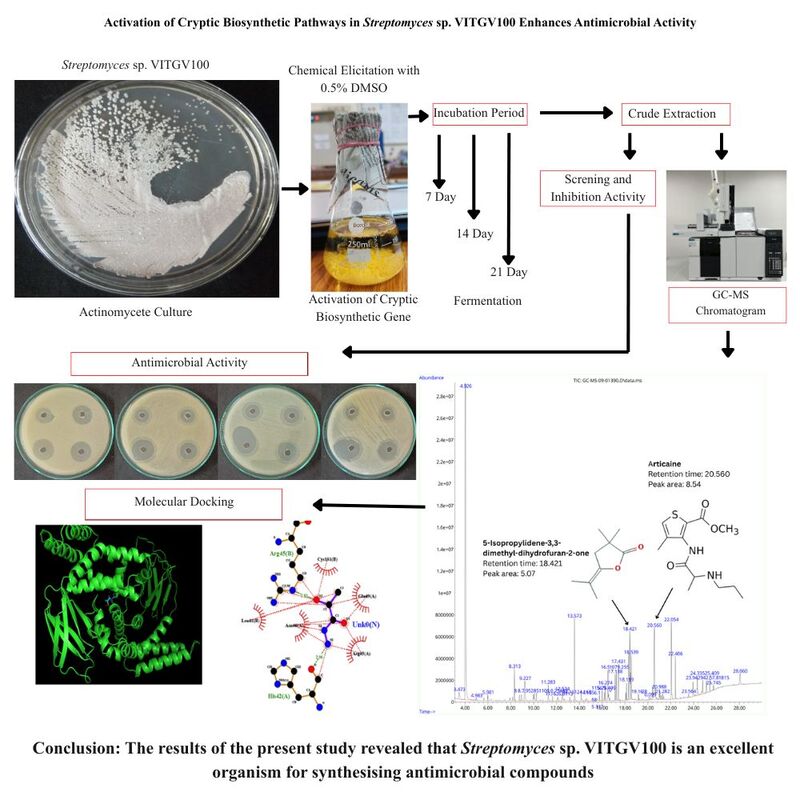
To achieve this, Streptomyces sp. VITGV100 was cultured in nutrient broth supplemented with 0.5% dimethyl sulfoxide (DMSO) to elicit metabolic changes over 7, 14, and 21 days. The resulting crude extracts were screened for antimicrobial activity against four human pathogens: Escherichia coli (Microbial Type Culture Collection and Gene Bank [MTCC] 1687), Pseudomonas aeruginosa (MTCC 3541), Bacillus subtilis (MTCC 2756), and Staphylococcus aureus (MTCC 737). Bioactive fractions were characterized by gas chromatography-mass spectrometry (GC-MS). Finally, identified compounds, namely lacthydrazide, were docked against target proteins: E. coli Z-ring-associated protein (5IMJ), P. aeruginosa OXA10 (4WZ5), S. aureus TyrRS (1JIJ), and B. subtilis DLTA (3E7X).
Results:
The 7-day crude extract exhibited the strongest antimicrobial activity, yielding a maximum inhibition zone of 31 mm against E. coli at 100 µg/ml and a minimum zone of 9 mm against B. subtilis at 25 µg/ml. GC-MS analysis revealed 45 distinct peaks in the included extracts versus 30 in controls, identifying lacthydrazide as a primary compound. Molecular docking confirmed the strong binding affinity of lacthydrazide to the target proteins, supporting its antimicrobial potential.
Conclusions:
Streptomyces sp. VITGV100, elicited with 0.5% DMSO, effectively activated cryptic genes to synthesize potent antibacterial compounds. These findings position this strain as a valuable resource for discovering novel antimicrobials.
The bacterial genus Streptomyces comprises well-known producers of bioactive compounds, mainly antibiotics. Specifically, the strain Streptomyces sp. VITGV100 shows promise as a potent antimicrobial source. This study investigates the activation of cryptic biosynthetic genes within this strain through chemical elicitation to amplify the production of secondary metabolites.
Material and methods:
To achieve this, Streptomyces sp. VITGV100 was cultured in nutrient broth supplemented with 0.5% dimethyl sulfoxide (DMSO) to elicit metabolic changes over 7, 14, and 21 days. The resulting crude extracts were screened for antimicrobial activity against four human pathogens: Escherichia coli (Microbial Type Culture Collection and Gene Bank [MTCC] 1687), Pseudomonas aeruginosa (MTCC 3541), Bacillus subtilis (MTCC 2756), and Staphylococcus aureus (MTCC 737). Bioactive fractions were characterized by gas chromatography-mass spectrometry (GC-MS). Finally, identified compounds, namely lacthydrazide, were docked against target proteins: E. coli Z-ring-associated protein (5IMJ), P. aeruginosa OXA10 (4WZ5), S. aureus TyrRS (1JIJ), and B. subtilis DLTA (3E7X).
Results:
The 7-day crude extract exhibited the strongest antimicrobial activity, yielding a maximum inhibition zone of 31 mm against E. coli at 100 µg/ml and a minimum zone of 9 mm against B. subtilis at 25 µg/ml. GC-MS analysis revealed 45 distinct peaks in the included extracts versus 30 in controls, identifying lacthydrazide as a primary compound. Molecular docking confirmed the strong binding affinity of lacthydrazide to the target proteins, supporting its antimicrobial potential.
Conclusions:
Streptomyces sp. VITGV100, elicited with 0.5% DMSO, effectively activated cryptic genes to synthesize potent antibacterial compounds. These findings position this strain as a valuable resource for discovering novel antimicrobials.
REFERENCES (37)
1.
Alam K, Mazumder A, Sikdar S, Zhao YM, Hao J, Song C, Wang Y, Sarkar R, Islam S, Zhang Y, et al. 2022. Streptomyces: the biofactory of secondary metabolites. Front Microbiol. 13: 968053. https://doi.org/10.3389/fmicb.....
2.
Al-Ansari M, Alkubaisi N, Vijayaragavan P, Murugan K. 2019. Antimicrobial potential of Streptomyces sp. to the Gram positive and Gram negative pathogens. J Infect Public Health. 12: 861–866. https://doi.org/10.1016/j.jiph....
3.
Charbe NB, Zacconi FC, Kowthavarapu VK, Gupta C, Palakurthi SS, Satheeshkumar R, Lokwani DK, Tambuwala MM, Palakurthi S. 2024. Targeting allosteric site of PCSK9 enzyme for the identification of small molecule inhibitors: an in silico drug repurposing study. Biomedicines 12: 286. https://doi.org/10.3390/biomed....
4.
Chaudhary KK, Mishra N. 2016. A review on molecular docking: novel tool for drug discovery. JSM Chem. 4: 1029.
5.
Dimri AG, Chauhan A, Aggarwal ML. 2020. Antibiotic potential of actinomycetes from different environments against human pathogens and microorganisms of industrial importance: a review. Sci Arch 01: 07–24. https://doi.org/10.47587/sa.20....
6.
Dolgonosov AM. 2017. The universal relationship between the energy and length of a covalent bond derived from the theory of generalized charges. Russ J Inorg Chem. 62: 344–350. https://doi.org/10.1134/S00360....
7.
El-Hawary SS, Hassan MHA, Hudhud AO, Abdelmohsen UR, Mohammed R. 2023. Elicitation for activation of the actinomycete genome’s cryptic secondary metabolite gene clusters. RSC Adv. 13: 5778–5795. https://doi.org/10.1039/d2ra08....
8.
El-Moslamy SH, Elnouby MS, Rezk AH, El-Fakharany EM. 2023. Scaling-up strategies for controllable biosynthetic ZnO NPs using cell free-extract of endophytic Streptomyces albus: characterization, statistical optimization, and biomedical activities evaluation. Sci Rep. 13: 3200. https://doi.org/10.1038/s41598....
9.
Fan J, Fu A, Zhang L. 2019. Progress in molecular docking. Quant Biol. 7: 83–89. https://doi.org/10.1007/s40484....
10.
Fanele A, Ndlovu SI. 2023. Endophytic fungal species Nigrospora oryzae and Alternaria alternata exhibit antimicrobial activity against gram-positive and gram-negative multi-drug resistant clinical bacterial isolates. BMC Complement Med Ther. 23: 323. https://doi.org/10.1186/s12906....
11.
Fu G, Batchelor C, Dumontier M, Hastings J, Willighagen E, Bolton E. 2015. PubChemRDF: towards the semantic annotation of PubChem compound and substance databases. J Cheminform. 7: 34. https://doi.org/10.1186/s13321....
12.
Heo L, Shin WH, Lee MS, Seok C. 2014. GalaxySite: ligand-binding-site prediction by using molecular docking. Nucleic Acids Res. 42: W210–W214. https://doi.org/10.1093/nar/gk....
13.
Hoskisson PA, Seipke RF. 2020. Cryptic or silent? The known unknowns, unknown knowns, and unknown unknowns of secondary metabolism. mBio 11: 10.1128/mbio.02642-20. https://doi.org/10.1128/mBio.0....
14.
Ikhrami MA, Widada J, Puspita ID, Putra MMP. 2021. The potency of chitosan as an elicitor on antibacterial activity of Streptomyces sp. GMR-22 against histamine-producing bacteria. Int J Biosci Biotechnol. 9: 1. https://doi.org/10.24843/ijbb.....
15.
Khoshmaram K, Yazdian F, Pazhouhnia Z, Lotfibakhshaiesh N. 2024. Preparation and characterization of 3D bioprinted gelatin methacrylate hydrogel incorporated with curcumin loaded chitosan nanoparticles for in vivo wound healing application. Biomater Adv. 156: 213677. https://doi.org/10.1016/j.bioa....
16.
Lee N, Hwang S, Kim W, Lee Y, Kim JH, Cho S, Kim HU, Yoon YJ, Oh MK, Palsson BO, et al. 2021. Systems and synthetic biology to elucidate secondary metabolite biosynthetic gene clusters encoded in Streptomyces genomes. Nat Prod Rep. 38: 1330–1361. https://doi.org/10.1039/D0NP00....
17.
Long F, Pu X, Wang X, Ma D, Gao S, Shi J, Zhong X, Ran R, Wang L, Chen Z, et al. 2025. A metabolic fingerprint of ovarian cancer: a novel diagnostic strategy employing plasma exosome-based metabolomics and machine learning algorithms. J Ovarian Res. 18: 26. https://doi.org/10.21203/rs.3.....
18.
Manikandan G, Pandiselvi P, Sobana N, Murugan M. 2019. GC-MS analysis of chemical constituents in the methanolic tuber extract of Momordica cymbalaria Hook. F. Int Res J Pharm. 10: 135–140. https://doi.org/10.7897/2230-8....
19.
Matsuda K, Hasebe F, Shiwa Y, Kanesaki Y, Tomita T, Yoshikawa H, Shinya K, Kuzuyama T, Nishiyama M. 2017. Genome mining of amino group carrier protein-mediated machinery: discovery and biosynthetic characterization of a natural product with unique hydrazone unit. ACS Chem Biol. 12(1): 124–131. https://doi.org/10.1021/acsche....
20.
Merbs CF. 1992. A new world of infectious disease. Am J Phys Anthropol. 35: 3–42. https://doi.org/10.1002/ajpa.1....
21.
Mohanty M, Mohanty PS. 2023. Molecular docking in organic, inorganic, and hybrid systems: a tutorial review. Monatsh Chem. 154: 683–707. https://doi.org/10.1007/s00706....
22.
Moon MM, Christopher JG. 2025. Chemical elicitors and their impact on secondary metabolite production in Streptomyces. Res J Biotechnol. 20: 246–256. https://doi.org/10.25303/207rj....
23.
Ndwigah IF, Bogai HI, Wanyoike W, Mwirichia RK. 2015. Characterization, enzymatic activity, and secondary metabolites of fungal isolates from Lake Sonachi in Kenya. J Pharm Biol Sci. 10: 65–76. https://doi.org/10.9790/3008-1....
24.
Onaka H. 2017. Novel antibiotic screening methods to awaken silent or cryptic secondary metabolic pathways in actinomycetes. J Antibiot. 70: 865–870. https://doi.org/10.1038/ja.201....
25.
Pagadala NS, Syed K, Tuszynski J. 2017. Software for molecular docking: a review. Biophys Rev. 9: 91–102. https://doi.org/10.1007/s12551....
26.
Rello J, Eshwara VK, Lagunes L, Alves J, Wunderink RG, Conway-Morris A, Rojas JN, Alp E, Zhang Z. 2018. A global priority list of the TOp TEn resistant Microorganisms (TOTEM) study at intensive care: a prioritization exercise based on multi-criteria decision analysis. Eur J Clin Microbiol Infect Dis. 38: 319–323. https://doi.org/10.1007/s10096....
27.
Salam MA, Al-Amin MY, Salam MT, Pawar JS, Akhter N, Rabaan AA, Alqumber MAA. 2023. Antimicrobial resistance: a growing serious threat for global public health. Healthcare 11: 1946. https://doi.org/10.3390/health....
28.
Salama SA, AL-Faifi ZE, El-Amier YA. 2022. Chemical composition of Reichardia tingitana methanolic extract and its potential antioxidant, antimicrobial, cytotoxic and larvicidal activity. Plants (Basel) 11: 2028. https://doi.org/10.3390/plants....
29.
Segall MD, Barber C. 2014. Addressing toxicity risk when designing and selecting compounds in early drug discovery. Drug Discov Today 19: 688–693. https://doi.org/10.1016/j.drud....
30.
Strobel G, Ericksen A, Sears J, Xie J, Geary B, Blatt B. 2017. Urnula sp., an endophyte of Dicksonia antarctica, making a fragrant mixture of biologically active volatile organic compounds. Microb Ecol. 74: 312–321. https://doi.org/10.1007/s00248....
31.
Tyurin AP, Alferova VA, Korshun VA. 2018. Chemical elicitors of antibiotic biosynthesis in actinomycetes. Microorganisms 6: 52. https://doi.org/10.3390/microo....
32.
Veilumuthu P, Nagarajan T, Sasikumar S, Siva R, Jose S, Godwin CJ. 2022. Streptomyces sp. VITGV100: an endophyte from Lycopersicon esculentum as new source of indole type compounds. Biochem Syst Ecol. 105: 104523. https://doi.org/10.1016/j.bse.....
33.
Wei Z, Sun Z, Wang Y, Dong S, Lv C, Wang T, Yan S, Wang C. 2020. Fourier transform infrared and gas chromatography-mass extracts from Euscaphis japonica bark. Therm Sci 24 (3 Part A): 1673–1680. https://doi.org/10.2298/TSCI19....
34.
Widmer AF. 2022. Emerging antibiotic resistance: Why we need new antibiotics! Swiss Med Wkly. 152: 40032. https://doi.org/10.57187/smw.2....
35.
Yıldırım Z. 2003. HPLC-UV and GC-MS characterization of the flavonol aglycons quercetin, kaempferol and myricetin in tomato pastes and other tomato-based products. Acta Chromatogr. 13: 196–207. https://www.researchgate.net/p....
36.
Zhu S, Duan Y, Huang Y. 2019. The application of ribosome engineering to natural product discovery and yield improvement in Streptomyces. Antibiotics 8: 133. https://doi.org/10.3390/antibi....
37.
Zong G, Fu J, Zhang P, Zhang W, Xu Y, Cao G, Zhang R. 2022. Use of elicitors to enhance or activate the antibiotic production in Streptomyces. Crit Rev Biotechnol. 42: 1260–1283. https://doi.org/10.1080/073885....
Share
RELATED ARTICLE
| eISSN: | 2353-9461 |
| ISSN: | 0860-7796 |

We process personal data collected when visiting the website. The function of obtaining information about users and their behavior is carried out by voluntarily entered information in forms and saving cookies in end devices. Data, including cookies, are used to provide services, improve the user experience and to analyze the traffic in accordance with the Privacy policy. Data are also collected and processed by Google Analytics tool (more).
You can change cookies settings in your browser. Restricted use of cookies in the browser configuration may affect some functionalities of the website.
You can change cookies settings in your browser. Restricted use of cookies in the browser configuration may affect some functionalities of the website.