Current issue
Online first
Archive
About the Journal
Editorial Office
Editorial Board
Publisher
Reviewers
Editorial policies
Ethical standards and procedures
Abstracting and indexing
Contact
Subscriptions & Orders
Instructions for authors
Article processing charge (APC)
English language editing services
Books and Events
Books
Events


RESEARCH PAPER
Predictive characterization and molecular docking of lignocellulolytic enzymes: comparative analyses of Moroccan fungal species

1
Laboratory of Biotechnology and Bioresources Valorization, Faculty of Sciences, Moulay Ismail University, BP 11201 Zitoune Meknes, Morocco
2
Laboratory of Biodiversity, Ecology and Genome, Plant and Microbial Biotechnology, Biodiversity and Environment Research Centre, Faculty of Sciences, Mohammed V University, BP 1014 RP, Rabat, Morocco
Submission date: 2025-10-09
Final revision date: 2026-03-01
Acceptance date: 2026-04-27
Publication date: 2026-08-20
Corresponding author
Soukaina Arif
Laboratory of Biotechnology and Bioresources Valorization, Faculty of Sciences, Moulay Ismail University, BP 11201 Zitoune Meknes, Morocco
Laboratory of Biotechnology and Bioresources Valorization, Faculty of Sciences, Moulay Ismail University, BP 11201 Zitoune Meknes, Morocco
BioTechnologia 2026;107(3):261-272
KEYWORDS
TOPICS
ABSTRACT
Background:
Lignocellulosic biomass has significant potential as a renewable feedstock for the production of biofuels and bioproducts. However, its structural complexity, particularly the crystalline nature of cellulose and protective lignin matrix, poses considerable challenges for enzymatic degradation. Fungi isolated from diverse lignocellulosic wastes, particularly olive pomace in Morocco, are a significant, yet underutilized resource of lignocellulolytic enzymes with a potential to overcome these challenges.
Material and methods:
This study investigated the structural and functional properties of lignocellulolytic enzymes derived from 9 filamentous fungi. A total of 80 curated sequences were systematically categorized into cellulases and ligninases. Phylogenetic analysis was conducted on representative endoglucanases, β-glucosidases, and laccases to assess their diversity. Physicochemical parameters, secondary structure content, and thermostability indices were determined using ExPASy ProtParam and SOPMA. Homology models were generated with SWISS-MODEL and validated through PROCHECK, ERRAT, and ProSA. Molecular docking with AutoDock was used to evaluate the interactions of β-glucosidase with cellobiose.
Results:
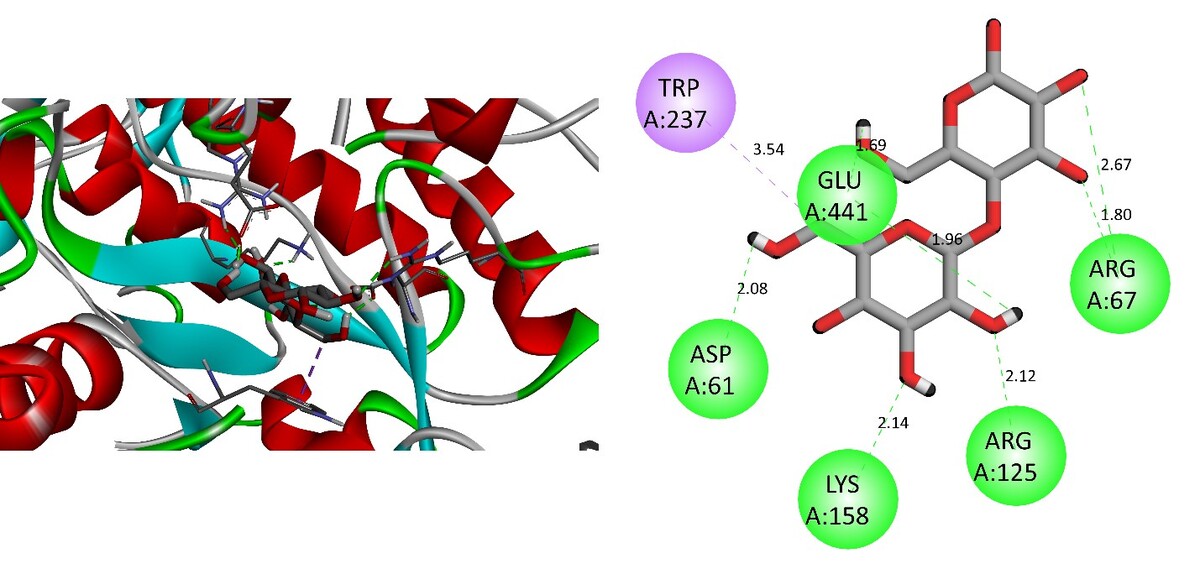
Phylogenetic analysis revealed high evolutionary diversity among the examined species. Several enzymes showed favorable aliphatic indices and GRAVY scores, suggesting thermostability and hydrophilicity. β-Glucosidase from Fusarium equiseti showed the strongest predicted binding energy to cellobiose (–5.32 kcal/mol), with hydrogen bonding mediated by key residues, including Asp88, Arg94, Lys185, Gln197, Asp276, and Gln278, at optimal distances (1.95–2.58 Å).
Conclusions:
This integrative in silico study highlights the predictive potential of Moroccan fungal β-glucosidases, particularly from F. equiseti, for future applications in lignocellulose bioconversion.
Lignocellulosic biomass has significant potential as a renewable feedstock for the production of biofuels and bioproducts. However, its structural complexity, particularly the crystalline nature of cellulose and protective lignin matrix, poses considerable challenges for enzymatic degradation. Fungi isolated from diverse lignocellulosic wastes, particularly olive pomace in Morocco, are a significant, yet underutilized resource of lignocellulolytic enzymes with a potential to overcome these challenges.
Material and methods:
This study investigated the structural and functional properties of lignocellulolytic enzymes derived from 9 filamentous fungi. A total of 80 curated sequences were systematically categorized into cellulases and ligninases. Phylogenetic analysis was conducted on representative endoglucanases, β-glucosidases, and laccases to assess their diversity. Physicochemical parameters, secondary structure content, and thermostability indices were determined using ExPASy ProtParam and SOPMA. Homology models were generated with SWISS-MODEL and validated through PROCHECK, ERRAT, and ProSA. Molecular docking with AutoDock was used to evaluate the interactions of β-glucosidase with cellobiose.
Results:
Phylogenetic analysis revealed high evolutionary diversity among the examined species. Several enzymes showed favorable aliphatic indices and GRAVY scores, suggesting thermostability and hydrophilicity. β-Glucosidase from Fusarium equiseti showed the strongest predicted binding energy to cellobiose (–5.32 kcal/mol), with hydrogen bonding mediated by key residues, including Asp88, Arg94, Lys185, Gln197, Asp276, and Gln278, at optimal distances (1.95–2.58 Å).
Conclusions:
This integrative in silico study highlights the predictive potential of Moroccan fungal β-glucosidases, particularly from F. equiseti, for future applications in lignocellulose bioconversion.
REFERENCES (37)
1.
Arif S, M’Barek HN, Bekaert B, Aziz M Ben, Diouri M, Haesaert G, Hajjaj H. 2024. Lignocellulolytic Enzymes Production by Four Wild Filamentous Fungi for Olive Stones Valorization: Comparing Three Fermentation Regimens. J Microbiol Biotechnol. 34(5): 1017–1028. https://doi.org/10.4014/jmb.23....
2.
Arif S, Nait M’Barek H, Oulghazi S, Audenaert K, Hajjaj H. 2022. Lignocellulose-degrading fungi newly isolated from central Morocco are potent biocatalysts for olive pomace valorization. Arch Microbiol. 204: 1–17. https://doi.org/10.1007/s00203....
3.
Barhoum A, Jeevanandam J, Rastogi A, Samyn P, Boluk Y, Dufresne A, Danquah MK, Bechelany M. 2020. Plant celluloses, hemicelluloses, lignins, and volatile oils for the synthesis of nanoparticles and nanostructured materials. Nanoscale. 12: 22845–22890. https://doi.org/10.1039/D0NR04....
4.
Benkert P, Biasini M, Schwede T. 2011. Toward the estimation of the absolute quality of individual protein structure models. Bioinformatics. 27(3): 343–350. https://doi.org/10.1093/bioinf....
5.
Buxbaum E. 2015. Fundamentals of Protein Structure and Function. Springer Cham. https://doi.org/10.1007/978-3-....
6.
Buzzo BB, Giuliatti S, Pereira PAM, Gomes-Pepe ES, Lemos EG de M. 2023. Molecular Docking of Lac_CB10: Highlighting the Great Potential for Bioremediation of Recalcitrant Chemical Compounds by One Predicted Bacteroidetes CopA-Laccase. Int J Mol Sci. 24(12): 9785. https://doi.org/10.3390/ijms24....
7.
Colovos C, Yeates TO. 1993. Verification of protein structures: Patterns of nonbonded atomic interactions. Protein Sci. 2: 1511–1519. https://doi.org/10.1002/pro.55....
8.
Combet C, Blanchet C, Geourjon C, Deléage G. 2000. NPS@: Network protein sequence analysis. Trends Biochem Sci. 25(3): 147–150. https://doi.org/10.1016/S0968-...) 01540-6.
9.
Dadheech T, Shah R, Pandit R, Hinsu A, Chauhan PS, Jakhesara S, Kunjadiya A, Rank D, Joshi C. 2018. Cloning, molecular modeling and characterization of acidic cellulase from buffalo rumen and its applicability in saccharification of lignocellulosic biomass. Int J Biol Macromol. 113: 73–81. https://doi.org/10.1016/j.ijbi....
10.
Erkanli ME, El-Halabi K, Kim JR. 2024. Exploring the diversity of b-glucosidase: Classification, catalytic mechanism, molecular characteristics, kinetic models, and applications. Enzyme Microb Technol. 173: 110363. https://doi.org/10.1016/j.enzm....
11.
Gasteiger E, Gattiker A, Hoogland C, Ivanyi I, Appel RD, Bairoch A. 2003. ExPASy: the proteomics server for in-depth protein knowledge and analysis. Nucleic Acids Res. 31(13): 3784–3788. https://doi.org/10.1093/nar/gk....
12.
Gasteiger E, Hoogland C, Gattiker A, Duvaud S, Wilkins MR, Appel RD, Bairoch A. 2005. Protein Identification and Analysis Tools on the ExPASy Server. In: Walker JM (ed.). The Proteomics Protocols Handbook. Humana Press, Totowa, NJ, pp. 571–607. https://doi.org/10.1385/1-5925....
13.
Gill SC, Hippel PHV. 1989. Calculation of protein extinction coefficients from amino acid sequence data. Anal Biochem. 182: 319–326. https://doi.org/10.1016/0003-2....
14.
Goyal A, Ghosh B, Eveleigh D. 1991. Characteristics of fungal cellulases. Bioresour Technol. 36(1): 37–50. https://doi.org/10.1016/0960-8....
15.
Guruprasad K, Reddy BVB, Pandit MW. 1990. Correlation between stability of a protein and its dipeptide composition: a novel approach for predicting in vivo stability of a protein from its primary sequence. Protein Eng. 4(2): 155–161. https://doi.org/10.1093/protei....
16.
Hao C, Zou Q, Bai X, Shi W. 2025. Effect of glycosylation on protein folding: from biological roles to chemical protein synthesis. iScience 28(6): 112605. https://doi.org/10.1016/j.isci....
17.
Ikai A. 1980. Thermostability and Aliphatic Index of Globular Proteins. J Biochem. 88(6): 1895–1898.
18.
Jahangeer M, Ur M, Rubina R, Muhammad N, Bushra N. 2025. Biotransformation of Lignocellulosic Biomass to Value Added Bioproducts: Insights into Bio Saccharification Strategies and Potential Concerns. Top Catal. 68: 929–950. https://doi.org/10.1007/s11244....
19.
Keller MB, Sørensen TH, Krogh KBRM. et al. 2020. Activity of fungal b-glucosidases on cellulose. Biotechnol Biofuels. 13: 121. https://doi.org/10.1186/s13068....
20.
Khairudin NBA, Mazlan NSF. 2013. Molecular docking study of beta-glucosidase with cellobiose, cellotetraose and cellotetriose. Bioinformation. 9(16): 813–817. https://doi.org/10.6026/973206....
21.
Kumar A, Chandra R. 2020. Ligninolytic enzymes and its mechanisms for degradation of lignocellulosic waste in environment. Heliyon. 6(2): e03170. https://doi.org/10.1016/j.heli....
22.
Kyte J, Doolittle RF. 1982. A simple method for displaying the hydropathic character of a protein. J Mol Biol. 157(1): 105–132. https://doi.org/10.1016/0022-2....
23.
Labourel A, Frandsen KEH, Zhang F, et al. 2020. A fungal family of lytic polysaccharide monooxygenase-like copper proteins. Nat Chem Biol. 16: 345–350. https://doi.org/10.1038/s41589....
24.
Larkin MA, Blackshields G, Brown NP, Chenna R, Mcgettigan PA, Mcwilliam H, Valentin F, Wallace IM, Wilm A, Lopez R, et al. 2007. Clustal W and Clustal X version 2.0. Bioinformatics. 23(21): 2947–2948. https://doi.org/10.1093/bioinf....
25.
Laskowski RA, MacArthur MW, Moss DS, Thornton JM. 1993. PROCHECK: a program to check the stereochemical quality of protein structures. J Appl Crystallogr. 26(2): 283–291. https://doi.org/10.1107/S00218....
26.
Lombard V, Ramulu HG, Drula E, Coutinho MP, Henrissat B. 2014. The carbohydrate-active enzymes database (CAZy) in 2013. Nucleic Acids Res. 42: D490–D495. https://doi.org/10.1093/nar/gk....
27.
Mazlan NSF, Khairudin NBA. 2014. Docking Study of b-glucosidase B (BglB) from P. polymyxca with Cellobiose and Cellotetrose. J Med Bioeng. 3(2): 78–83.
28.
Poomani MS, James SB, Muthan K, Subramanian V. 2024. Unravelling yeast cellulase potential: a computational approach to structural study, cellulolytic activity, and docking. J Mol Struct. 1300: 137254. https://doi.org/10.1016/j.mols....
29.
Ramakrishnan K, Johnson RL, Winter SD, Worthy HL, Thomas C, Humer DC, Spadiut O, Hindson SH, Wells S, Barratt AH, Menzies GE, Pudney CR, Jones DD. 2023. Glycosylation increases active site rigidity leading to improved enzyme stability and turnover. FEBS Journal 290(15): 3812–3827. https://doi.org/10.1111/febs.1....
30.
Rogers S, Wells R, Rechsteiner M. 1860. Acid Sequences Common to Rapidly Degraded Proteins: The PEST Hypothesis. Science. 234(4774): 364–648. https://doi.org/10.1126/scienc....
31.
Schwede T, Kopp J, Guex N, Peitsch MC. 2003. SWISS-MODEL: An automated protein homology-modeling server. Nucleic Acids Res. 31(13): 3381–3385. https://doi.org/10.1093/nar/gk....
32.
Selvam K, Senbagam D, Selvankumar T, Sudhakar C, Senthilkumar B, Govarthanan M. 2017. Cellulase enzyme: homology modeling, binding site identification and molecular docking. J Mol Struct. 1150: 61–67. https://doi.org/10.1016/j.mols....
33.
Singhania RR, Patel AK, Saini R, Pandey A. 2017. Industrial Enzymes: b-Glucosidases. Curr Dev Biotechnol Bioeng. 103–125. https://doi.org/10.1016/B978-0....
34.
Tamboli AS, Rane NR, Patil SM, Biradar SP. 2015. Physicochemical characterization, structural analysis and homology modeling of bacterial and fungal laccases using in silico methods. Netw Model Anal Health Inform Bioinforma. 4: 17. https://doi.org/10.1007/s13721....
35.
Wang Y, Jiao M, Zhao Z, Wang Y, Li T, Wei Y, Li R, Yag F. 2024. Insight into the role of niche concept in deciphering the ecological drivers of MPs-associated bacterial communities in mangrove forest. Water Res. 249: 120995. https://doi.org/10.1016/j.watr....
36.
Wiederstein M, Sippl MJ. 2007. ProSA-web: Interactive web service for the recognition of errors in three-dimensional structures of proteins. Nucleic Acids Res. 35. https://doi.org/10.1093/nar/gk....
37.
Xiao M, Liu YJ, Bayer EA, Kosugi A, Cui Q, Feng Y. 2024. Cellulosomal hemicellulases: Indispensable players for ensuring effective lignocellulose bioconversion. Green Carbon. 2(1): 57–69. https://doi.org/10.1016/j.gree....
Share
RELATED ARTICLE
| eISSN: | 2353-9461 |
| ISSN: | 0860-7796 |

We process personal data collected when visiting the website. The function of obtaining information about users and their behavior is carried out by voluntarily entered information in forms and saving cookies in end devices. Data, including cookies, are used to provide services, improve the user experience and to analyze the traffic in accordance with the Privacy policy. Data are also collected and processed by Google Analytics tool (more).
You can change cookies settings in your browser. Restricted use of cookies in the browser configuration may affect some functionalities of the website.
You can change cookies settings in your browser. Restricted use of cookies in the browser configuration may affect some functionalities of the website.