Current issue
Online first
Archive
About the Journal
Editorial Office
Editorial Board
Publisher
Reviewers
Editorial policies
Ethical standards and procedures
Abstracting and indexing
Contact
Subscriptions & Orders
Instructions for authors
Article processing charge (APC)
English language editing services
Books and Events
Books
Events


REVIEW PAPER
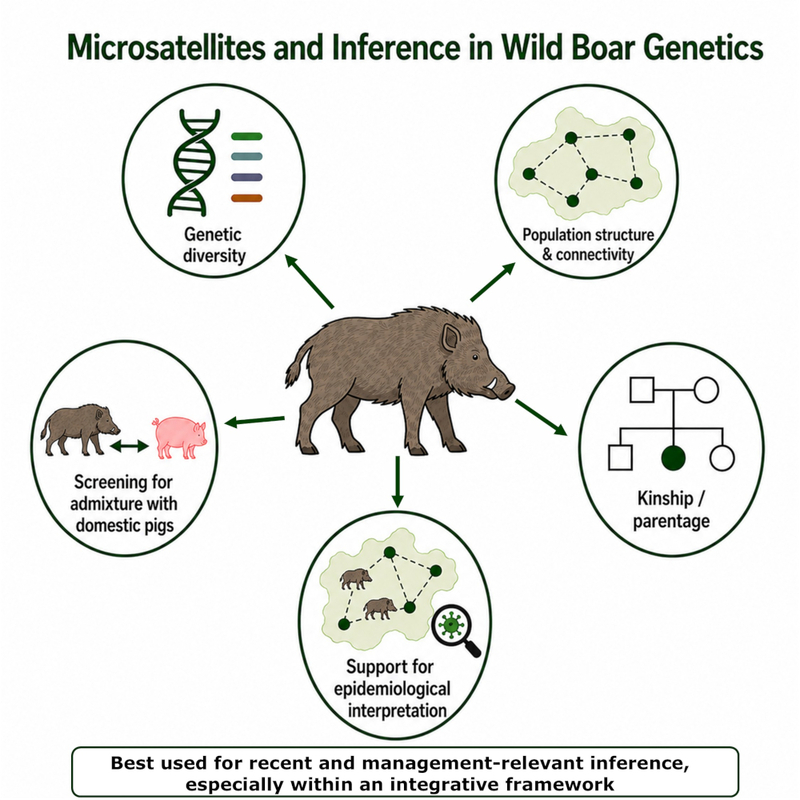
Microsatellite genotyping and computational inference for genetic management of the Eurasian wild boar (Sus scrofa L., 1758): strengths, limitations, and integrative applications
1
Department of Microbiology and Immunobiology, Faculty of Biological Sciences, Kazimierz Wielki University, Bydgoszcz, Poland
2
Doctoral School, Kazimierz Wielki University, Bydgoszcz, Poland
3
Department of Veterinary Medicine, University of Sassari, Sassari, Italy
4
National Biodiversity Future Center – NBFC, Palermo, Italy
5
Department of Chemistry and Bioscience, Aalborg University, Aalborg, Denmark
6
Department of Genetics, Faculty of Biological Sciences, Kazimierz Wielki University, Bydgoszcz, Poland
Submission date: 2026-03-12
Final revision date: 2026-07-10
Acceptance date: 2026-07-24
Publication date: 2026-09-09
Corresponding author
Wojciech Lipa
Department of Microbiology and Immunobiology, Faculty of Biological Sciences, Kazimierz Wielki University, Aleja Powstańców Wielkopolskich 10, 85-090 Bydgoszcz, Poland
Department of Microbiology and Immunobiology, Faculty of Biological Sciences, Kazimierz Wielki University, Aleja Powstańców Wielkopolskich 10, 85-090 Bydgoszcz, Poland
BioTechnologia 2026;107(3):303-316
KEYWORDS
TOPICS
ABSTRACT
Microsatellite markers, commonly referred to as short tandem repeats (STRs) or simple sequence repeats, have been extensively utilized in population genetic studies of the Eurasian wild boar (Sus scrofa L., 1758), particularly for assessing genetic diversity, population structure, connectivity, relatedness, and admixture with domestic pigs (Sus scrofa domesticus L., 1758). Despite the increasing availability of single nucleotide polymorphism (SNP)-based and whole-genome approaches, STR datasets remain valuable because of their high polymorphism, relatively low cost, and compatibility with legacy monitoring data. This review provides a critical synthesis of the use of microsatellite genotyping in wild boar research, with particular emphasis on the computational inference frameworks used to translate multi-locus genotypes into management-relevant information. We discuss the application of STR data to diversity and inbreeding metrics, clustering and assignment analyses, effective population size and bottleneck inference, parentage and kinship reconstruction, admixture detection, landscape genetics, and disease-related interpretation. Special emphasis is placed on the assumptions and limitations of microsatellite-based inference, including marker panel size and comparability, sampling design, allele binning, null alleles, genotyping error, allele-size homoplasy, and the temporal scale of interpretation. The review highlights that STRs provide substantial insights into recent and fine-scale population processes, regional monitoring, and preliminary admixture screening, whereas dense SNP panels or whole-genome data are required for precise introgression quantification, adaptive inference, complex demographic reconstruction, and deep phylogeographic analysis. Used within an integrative framework that combines genomic, landscape, epidemiological, and long-term monitoring data, STRs remain a cost-effective and informative component of genetic monitoring for S. scrofa across heterogeneous and human-modified landscapes.
REFERENCES (86)
1.
Alexandri P, Megens HJ, Crooijmans RPMA, Groenen MAM, Goedbloed DJ, Herrero-Medrano JM, Rund LA, Schook LB, Chatzinikos E, Triantaphyllidis C, et al. 2017. Distinguishing migration events of different timing for wild boar in the Balkans. J Biogeogr. 44: 259–270. https://doi.org/10.1111/ jbi.12861.
2.
Alkhamis MA, Gallardo C, Jurado C, Soler A, Arias M, Sánchez-Vizcaíno JM. 2018. Phylodynamics and evolutionary epidemiology of African swine fever p72-CVR genes in Eurasia and Africa. PLoS One 13: e0192565. https://doi.org/10.1371/JOURNA....
3.
Anderson D, Negishi Y, Ishiniwa H, Okuda K, Hinton TG, Toma R, Nagata J, Tamate HB, Kaneko S. 2021. Introgression dynamics from invasive pigs into wild boar following the March 2011 natural and anthropogenic disasters at Fukushima. Proc R Soc B. 288: 20210874. https://doi.org/10.1098/rspb.2....
4.
Anderson D, Negishi Y, Toma R, Nagata J, Tamate H, Kaneko S. 2020. Robust microsatellite markers for hybrid analysis between domesticated pigs and wild boar: markers for pig and wild boar hybridization. Genet Resour. 1: 29–41. https://doi.org/10.46265/genre....
5.
Anderson EC, Thompson EA. 2002. A model-based method for identifying species hybrids using multilocus genetic data. Genetics. 160: 1217–1229. https://doi.org/10.1093/GENETI....
6.
Antão-Sousa S, Pinto N, Rende P, Amorim A, Gusmão L. 2023. The sequence of the repetitive motif influences the frequency of multistep mutations in short tandem repeats. Sci Rep. 13: 10251. https://doi.org/10.1038/s41598....
7.
Bagshaw ATM. 2017. Functional mechanisms of microsatellite DNA in eukaryotic genomes. Genome Biol Evol. 9: 2428–2443. https://doi.org/10.1093/gbe/ev....
8.
Blouin MS. 2003. DNA-based methods for pedigree reconstruction and kinship analysis in natural populations. Trends Ecol Evol. 18: 503–511. https://doi.org/10.1016/S0169-....
9.
Böheim D, Knauer F, Stefanović M, Zink R, Kübber-Heiss A, Posautz A, Beiglböck C, Dressler A, Strauss V, Dier H, et al. 2023. Signals of pig ancestry in wild boar, Sus scrofa, from eastern Austria: current hybridisation or incomplete gene pool differentiation and historical introgressions? Diversity 15: 790. https://doi.org/10.3390/d15060....
10.
Bonin A, Bellemain E, Eidesen PB, Pompanon F, Brochmann C, Taberlet P. 2004. How to track and assess genotyping errors in population genetics studies. Mol Ecol. 13: 3261–3273. https://doi.org/10.1111/J.1365....
11.
Bruford MW, Wayne RK. 1993. Microsatellites and their application to population genetic studies. Curr Opin Genet Dev. 3: 939–943. https://doi.org/10.1016/0959-4....
12.
Chapuis MP, Estoup A. 2007. Microsatellite null alleles and estimation of population differentiation. Mol Biol Evol. 24: 621–631. https://doi.org/10.1093/MOLBEV....
13.
Choi SK, Lee JE, Kim YJ, Min MS, Voloshina I, Myslenkov A, Oh JG, Kim TH, Markov N, Seryodkin I, et al. 2014. Gene-tic structure of wild boar (Sus scrofa) populations from East Asia based on microsatellite loci analyses. BMC Genet. 15: 85. https://doi.org/10.1186/1471-2....
14.
Cornuet JM, Luikart G. 1996. Description and power analysis of two tests for detecting recent population bottlenecks from allele frequency data. Genetics 144: 2001. https://doi.org/10.1093/geneti....
15.
Costa V, Pérez-González J, Santos P, Fernández-Llario P, Carranza J, Zsolnai A, Anton I, Buzgá J, Varga G, Monteiro N, et al. 2012. Microsatellite markers for identification and parentage analysis in the European wild boar (Sus scrofa). BMC Res Notes 5: 479. https://doi.org/10.1186/1756-0....
16.
Dakin EE, Avise JC. 2004. Microsatellite null alleles in parentage analysis. Heredity. 93: 504–509. https://doi.org/10.1038/SJ.HDY....
17.
De Barba M, Miquel C, Lobréaux S, Quenette PY, Swenson JE, Taberlet P. 2017. High-throughput microsatellite genotyping in ecology: improved accuracy, efficiency, standardization and success with low-quantity and degraded DNA. Mol Ecol Resour. 17: 492–507. https://doi.org/10.1111/1755-0....
18.
De Jong JF, Iacolina L, Prins HHT, van Hooft P, Crooijmans RPMA, van Wieren SE, Baños JV, Baubet E, Cahill S, Ferreira E, et al. 2023. Spatial genetic structure of European wild boar, with inferences on late-Pleistocene and Holocene demographic history. Heredity 130: 135–144. https://doi.org/10.1038/s41437....
19.
Do C, Waples RS, Peel D, Macbeth GM, Tillett BJ, Ovenden JR. 2014. NeEstimator v2: re-implementation of software for the estimation of contemporary effective population size (Ne) from genetic data. Mol Ecol Resour. 14: 209–214. https://doi.org/10.1111/1755-0....
20.
Ellegren H. 2004. Microsatellites: simple sequences with complex evolution. Nat Rev Genet. 5: 435–445. https://doi.org/10.1038/NRG134....
21.
Estoup A, Jarne P, Cornuet JM. 2002. Homoplasy and mutation model at microsatellite loci and their consequences for population genetics analysis. Mol Ecol. 11: 1591–1604. https://doi.org/10.1046/J.1365....
22.
Evanno G, Regnaut S, Goudet J. 2005. Detecting the number of clusters of individuals using the software STRUCTURE: a simulation study. Mol Ecol. 14: 2611–2620. https://doi.org/10.1111/J.1365....
23.
Fan H, Chu JY. 2007. A brief review of short tandem repeat mutation. Genom Proteom Bioinform. 5: 7. https://doi.org/10.1016/S1672-....
24.
Frantz AC, Cellina S, Krier A, Schley L, Burke T. 2009. Using spatial Bayesian methods to determine the genetic structure of a continuously distributed population: clusters or isolation by distance? J Appl Ecol. 46: 493–505. https://doi.org/10.1111/J.1365....
25.
Frantz AC, Zachos FE, Kirschning J, Cellina S, Bertouille S, Mamuris Z, Koutsogiannouli EA, Burke T. 2013. Genetic evidence for introgression between domestic pigs and wild boars (Sus scrofa) in Belgium and Luxembourg: a comparative approach with multiple marker systems. Biol J Linn Soc. 110: 104–115. https://doi.org/10.1111/bij.12....
26.
Gamelon M, Coudrin JP, Capron G, Gilot A, Baubet É, Cachelou J, Gaillard JM. 2025. Natal dispersal patterns in a social wild mammal: what does family tell us? Ecology 106: e70190. https://doi.org/10.1002/ECY.70....
27.
Garza JC, Williamson EG. 2001. Detection of reduction in population size using data from microsatellite loci. Mol Ecol. 10: 305–318. https://doi.org/10.1046/j.1365....
28.
Goedbloed DJ, van Hooft P, Megens HJ, Langenbeck K, Lutz W, Crooijmans RPMA, van Wieren SE, Ydenberg RC, Prins HHT. 2013. Reintroductions and genetic introgression from domestic pigs have shaped the genetic population structure of Northwest European wild boar. BMC Genet. 14: 43. https://doi.org/10.1186/1471-2....
29.
Goicolea T, Cisneros-Araújo P, Vega CA, Sánchez-Vizcaíno JM, Mateo-Sánchez MC, Bosch J. 2024. Landscape connectivity for predicting the spread of ASF in the European wild boar population. Sci Rep. 14: 3414. https://doi.org/10.1038/s41598....
30.
Griciuvienė L, Janeliūnas Ž, Jurgelevičius V, Paulauskas A. 2021. The effects of habitat fragmentation on the genetic structure of wild boar (Sus scrofa) population in Lithuania. BMC Genom Data 22: 53. https://doi.org/10.1186/s12863....
31.
Griciuvienė L, Janeliūnas Ž, Pilevičienė S, Jurgelevičius V, Paulauskas A. 2022. Changes in the genetic structure of Lithuania’s wild boar (Sus scrofa) population following the outbreak of African swine fever. Genes 13: 1561. https://doi.org/10.3390/genes1....
32.
Guichoux E, Lagache L, Wagner S, Chaumeil P, Léger P, Lepais O, Lepoittevin C, Malausa T, Revardel E, Salin F, et al. 2011. Current trends in microsatellite genotyping. Mol Ecol Resour. 11: 591–611. https://doi.org/10.1111/j.1755....
33.
Hale ML, Burg TM, Steeves TE. 2012. Sampling for microsatellite-based population genetic studies: 25 to 30 individuals per population is enough to accurately estimate allele frequencies. PLoS One 7: e45170. https://doi.org/10.1371/JOURNA....
34.
Hauser SS, Athrey G, Leberg PL. 2021. Waste not, want not: microsatellites remain an economical and informative technology for conservation genetics. Ecol Evol. 11: 15800. https://doi.org/10.1002/ece3.8....
35.
Holderegger R, Wagner HH. 2008. Landscape genetics. BioScience 58: 199–207. https://doi.org/10.1641/B58030....
36.
Johansson AM, Dalin AM, Jonas E, Mikko S, Malmsten A. 2026. Wild or tame? In search for the genetic origin of wild boar (Sus scrofa) in Sweden. Ecol Evol. 16: e73369. https://doi.org/10.1002/ece3.7....
37.
Jombart T, Devillard S, Balloux F. 2010. Discriminant analysis of principal components: a new method for the analysis of genetically structured populations. BMC Genet. 11: 94. https://doi.org/10.1186/1471-2....
38.
Jones OR, Wang J. 2010. COLONY: a program for parentage and sibship inference from multilocus genotype data. Mol Ecol Resour. 10: 551–555. https://doi.org/10.1111/J.1755....
39.
Kierepka EM, Unger SD, Keiter DA, Beasley JC, Rhodes OE, Cunningham FL, Piaggio AJ. 2016. Identification of robust microsatellite markers for wild pig fecal DNA. J Wildl Manag. 80: 1120–1128. https://doi.org/10.1002/jwmg.2....
40.
Kruglyak S, Durrett RT, Schug MD, Aquadro CF. 1998. Equilibrium distributions of microsatellite repeat length resulting from a balance between slippage events and point mutations. Proc Natl Acad Sci USA 95: 10774–10778. https://doi.org/10.1073/pnas.9....
41.
Kusza S, Podgórski T, Scandura M, Borowik T, Jávor A, Sidorovich VE, Bunevich AN, Kolesnikov M, Jêdrzejewska B. 2014. Contemporary genetic structure, phylogeography and past demographic processes of wild boar Sus scrofa population in Central and Eastern Europe. PLoS One 9: e91401. https://doi.org/10.1371/journa....
42.
Lecis R, Dondina O, Orioli V, Biosa D, Canu A, Fabbri G, Iacolina L, Cossu A, Bani L, Apollonio M, et al. 2022. Main roads and land cover shaped the genetic structure of a Mediterranean island wild boar population. Ecol Evol. 12: e8804. https://doi.org/10.1002/ece3.8....
43.
Lepais O, Chancerel E, Boury C, Salin F, Manicki A, Taillebois L, Dutech C, Aissi A, Bacles CFE, Daverat F, et al. 2020. Fast sequence-based microsatellite genotyping development workflow. PeerJ. 2020: e9085. https://doi.org/10.7717/peerj.....
44.
Levinson G, Gutman GA. 1987. Slipped-strand mispairing: a major mechanism for DNA sequence evolution. Mol Biol Evol. 4: 203–221. https://doi.org/10.1093/oxford....
45.
Manel S, Gaggiotti OE, Waples RS. 2005. Assignment methods: matching biological questions with appropriate techniques. Trends Ecol Evol. 20: 136–142. https://doi.org/10.1016/j.tree....
46.
Manel S, Schwartz MK, Luikart G, Taberlet P. 2003. Landscape genetics: combining landscape ecology and population genetics. Trends Ecol Evol. 18: 189–197. https://doi.org/10.1016/S0169-....
47.
Marshall TC, Slate J, Kruuk LEB, Pemberton JM. 1998. Statistical confidence for likelihood-based paternity inference in natural populations. Mol Ecol. 7: 639–655. https://doi.org/10.1046/J.1365....
48.
Mary N, Iannuccelli N, Petit G, Bonnet N, Pinton A, Barasc H, Faure A, Calgaro A, Grosbois V, Servin B, et al. 2022. Genome-wide analysis of hybridization in wild boar populations reveals adaptive introgression from domestic pig. Evol Appl. 15: 1115–1128. https://doi.org/10.1111/eva.13....
49.
Massei G, Kindberg J, Licoppe A, Gačić D, Šprem N, Kamler J, Baubet E, Hohmann U, Monaco A, Ozoliņš J, et al. 2015. Wild boar populations up, numbers of hunters down? A review of trends and implications for Europe. Pest Manag Sci. 71: 492–500. https://doi.org/10.1002/PS.396....
50.
Mazloum A, van Schalkwyk A, Shotin A, Zinyakov N, Igolkin A, Chernishev R, Debeljak Z, Korennoy F, Sprygin AV. 2023. Whole-genome sequencing of African swine fever virus from wild boars in the Kaliningrad region reveals unique and distinguishing genomic mutations. Front Vet Sci. 9: 1019808. https://doi.org/10.3389/FVETS.....
51.
Meirmans PG. 2012. The trouble with isolation by distance. Mol Ecol. 21: 2839–2846. https://doi.org/10.1111/J.1365....
52.
Meirmans PG. 2015. Seven common mistakes in population genetics and how to avoid them. Mol Ecol. 24: 3223–3231. https://doi.org/10.1111/MEC.13....
53.
Meletiadis A, Garcia-Vozmediano A, Riina MV, Vitale N, Di Nicola MR, Maurella C, Massimino M, Caniglia R, Moroni B, Viani A, et al. 2025. Genetic connectivity and admixture zones shape the spread of African swine fever in wild boar populations in North-western Italy. Sci Rep. 16: 2731. https://doi.org/10.1038/s41598....
54.
Mihalik B, Frank K, Astuti PK, Szemethy D, Szendrei L, Szemethy L, Kusza S, Stéger V. 2020. Population genetic structure of the wild boar (Sus scrofa) in the Carpathian Basin. Genes 11: 1194. https://doi.org/10.3390/genes1....
55.
Niedziałkowska M, Tarnowska E, Ligmanowska J, Jêdrzejewska B, Podgórski T, Radziszewska A, Ratajczyk I, Kusza S, Bunevich AN, Danila G, et al. 2021. Clear phylogeographic pattern and genetic structure of wild boar Sus scrofa population in Central and Eastern Europe. Sci Rep. 11. https://doi.org/10.1038/s41598....
56.
Osborne MJ, Caeiro-Dias G, Turner TF. 2023. Transitioning from microsatellites to SNP-based microhaplotypes in genetic monitoring programmes: lessons from paired data spanning 20 years. Mol Ecol. 32: 316–334. https://doi.org/10.1111/mec.16....
57.
Paetkau D, Slade R, Burden M, Estoup A. 2004. Genetic assignment methods for the direct, real-time estimation of migration rate: a simulation-based exploration of accuracy and power. Mol Ecol. 13: 55–65. https://doi.org/10.1046/J.1365....
58.
Peery ZM, Kirby R, Reid BN, Stoelting R, Doucet-Bëer E, Robinson S, Vásquez-Carrillo C, Pauli JN, Palsboll PJ. 2012. Reliability of genetic bottleneck tests for detecting recent population declines. Mol Ecol. 21: 3403–3418. https://doi.org/10.1111/j.1365....
59.
Pepin KM, Golnar A, Podgórski T. 2021. Social structure defines spatial transmission of African swine fever in wild boar. J R Soc Interface 18: 20200761. https://doi.org/10.1098/rsif.2....
60.
Podgórski T, Lusseau D, Scandura M, Sönnichsen L, Jêdrzejewska B. 2014. Long-lasting, kin-directed female interactions in a spatially structured wild boar social network. PLoS One 9: e99875. https://doi.org/10.1371/journa....
61.
Poteaux C, Baubet E, Kaminski G, Brandt S, Dobson FS, Baudoin C. 2009. Socio-genetic structure and mating system of a wild boar population. J Zool. 278: 116–125. https://doi.org/10.1111/j.1469....
62.
Pritchard JK, Stephens M, Donnelly P. 2000. Inference of population structure using multilocus genotype data. Genetics 155: 945–959. https://doi.org/10.1093/GENETI....
63.
Puechmaille SJ. 2016. The program structure does not reliably recover the correct population structure when sampling is uneven: subsampling and new estimators alleviate the problem. Mol Ecol Resour. 16: 608–627. https://doi.org/10.1111/1755-0....
64.
Putman AI, Carbone I. 2014. Challenges in analysis and interpretation of microsatellite data for population genetic studies. Ecol Evol. 4: 4399. https://doi.org/10.1002/ece3.1....
65.
Rannala B, Mountain JL. 1997. Detecting immigration by using multilocus genotypes. Proc Natl Acad Sci USA 94: 9197–9201. https://doi.org/10.1073/pnas.9....
66.
Reinar WB, Krabberød AK, Lalun VO, Butenko MA, Jakobsen KS. 2024. Short tandem repeats delineate gene bodies across eukaryotes. Nat Commun. 15: 10902. https://doi.org/10.1038/s41467....
67.
Rodrigáñez J, Barragán C, Alves E, Gortázar C, Toro MA, Silió L. 2008. Genetic diversity and allelic richness in Spanish wild and domestic pig population estimated from microsatellite markers. Span J Agric Res. 6: 107–115. https://doi.org/10.5424/sjar/2....
68.
Salih D, Armstrong EE, Robbins CT, Waits LP, Kelley JL. 2025. Bridging the gap between legacy PCR-based microsatellite data with high-throughput sequencing data in conservation genomics. J Hered. https://doi.org/10.1093/jhered....
69.
Šarhanová P, Pfanzelt S, Brandt R, Himmelbach A, Blattner FR. 2018. SSR-seq: genotyping of microsatellites using next-generation sequencing reveals higher level of polymorphism as compared to traditional fragment size scoring. Ecol Evol. 8: 10817. https://doi.org/10.1002/ECE3.4....
70.
Sawai K, Arakawa A, Taniguchi M, Xiao B, Sawai M, Osaki M, Yamaguchi E, Hayama Y, Murato Y, Shimizu Y, et al. 2023. Assessing population structure and migration patterns of wild boar (Sus scrofa) in Japan. Sci Rep. 13: 21186. https://doi.org/10.1038/s41598....
71.
Scandura M, Iacolina L, Apollonio M. 2011. Genetic diversity in the European wild boar Sus scrofa: phylogeography, population structure and wild × domestic hybridization. Mamm Rev. 41: 125–137. https://doi.org/10.1111/j.1365....
72.
Scandura M, Iacolina L, Crestanello B, Pecchioli E, Di Benedetto MF, Russo V, Davoli R, Apollonio M, Bertorelle G. 2008. Ancient vs. recent processes as factors shaping the genetic variation of the European wild boar: are the effects of the last glaciation still detectable? Mol Ecol. 17: 1745–1762. https://doi.org/10.1111/j.1365....
73.
Schleimer A, Richart L, Drygala F, Casabianca F, Maestrini O, Weigand H, Schwartz C, Mittelbronn M, Frantz AC. 2022. Introgressive hybridisation between domestic pigs (Sus scrofa domesticus) and endemic Corsican wild boars (S. s. meridionalis): effects of human-mediated interventions. Heredity 128: 279–290. https://doi.org/10.1038/s41437....
74.
Schlotterer C. 2000. Evolutionary dynamics of microsatellite DNA. Chromosoma 109: 365–371. https://doi.org/10.1007/s00412....
75.
Selkoe KA, Toonen RJ. 2006. Microsatellites for ecologists: a practical guide to using and evaluating microsatellite markers. Ecol Lett. 9: 615–629. https://doi.org/10.1111/J.1461....
76.
Simon U, Gerhards K, Becker S, Willems H, Friedrichs V, Forth JH, Calvelage S, Blome S, Reiner G. 2024. Genetic differentiation of wild boar populations in a region affected by African swine fever. Eur J Wildl Res. 70: 54. https://doi.org/10.1007/s10344....
77.
Storfer A, Murphy MA, Evans JS, Goldberg CS, Robinson S, Spear SF, Dezzani R, Delmelle E, Vierling L, Waits LP. 2006. Putting the ‘landscape’ in landscape genetics. Heredity 98: 128–142. https://doi.org/10.1038/sj.hdy....
78.
Vähä JP, Primmer CR. 2006. Efficiency of model-based Bayesian methods for detecting hybrid individuals under different hybridization scenarios and with different numbers of loci. Mol Ecol. 15: 63–72. https://doi.org/10.1111/J.1365....
79.
Van Oosterhout C, Hutchinson WF, Wills DPM, Shipley P. 2004. Micro-checker: software for identifying and correcting genotyping errors in microsatellite data. Mol Ecol Notes 4: 535–538. https://doi.org/10.1111/j.1471....
80.
Veličković N, Ferreira E, Djan M, Ernst M, Obreht Vidaković D, Monaco A, Fonseca C. 2016. Demographic history, current expansion and future management challenges of wild boar populations in the Balkans and Europe. Heredity 117: 348–357. https://doi.org/10.1038/hdy.20....
81.
Waits LP, Paetkau D. 2005. Noninvasive genetic sampling tools for wildlife biologists: a review of applications and recommendations for accurate data collection. J Wildl Manag. 69: 1419–1433. https://doi.org/10.2193/0022-5...) 69[1419:NGSTFW]2.0.CO;2.
82.
Wang J. 2011. Coancestry: a program for simulating, estimating and analysing relatedness and inbreeding coefficients. Mol Ecol Resour. 11: 141–145. https://doi.org/10.1111/j.1755....
83.
Wang Z, Li Z, Huang T, Chen J, Xu P, Qiao R, Yin H, Song C, Zhang D, Liu D, et al. 2025. Genomic insights into the demographic history and local adaptation of wild boars across Eurasia. Cell Genom. 5: 100954. https://doi.org/10.1016/j.xgen....
84.
Waples RS, Do C. 2010. Linkage disequilibrium estimates of contemporary Ne using highly variable genetic markers: a largely untapped resource for applied conservation and evolution. Evol Appl. 3: 244–262. https://doi.org/10.1111/J.1752....
85.
Wright SE, Todd PK. 2023. Native functions of short tandem repeats. eLife 12: e84043. https://doi.org/10.7554/eLife.....
86.
Zemanova MA. 2021. Noninvasive genetic assessment is an effective wildlife research tool when compared with other approaches. Genes 12: 1672. https://doi.org/10.3390/genes1....
| eISSN: | 2353-9461 |
| ISSN: | 0860-7796 |

We process personal data collected when visiting the website. The function of obtaining information about users and their behavior is carried out by voluntarily entered information in forms and saving cookies in end devices. Data, including cookies, are used to provide services, improve the user experience and to analyze the traffic in accordance with the Privacy policy. Data are also collected and processed by Google Analytics tool (more).
You can change cookies settings in your browser. Restricted use of cookies in the browser configuration may affect some functionalities of the website.
You can change cookies settings in your browser. Restricted use of cookies in the browser configuration may affect some functionalities of the website.